Blog/10 Home Business Ideas in India You Can Start From Your Kitchen or Living Room
10 Home Business Ideas in India You Can Start From Your Kitchen or Living Room
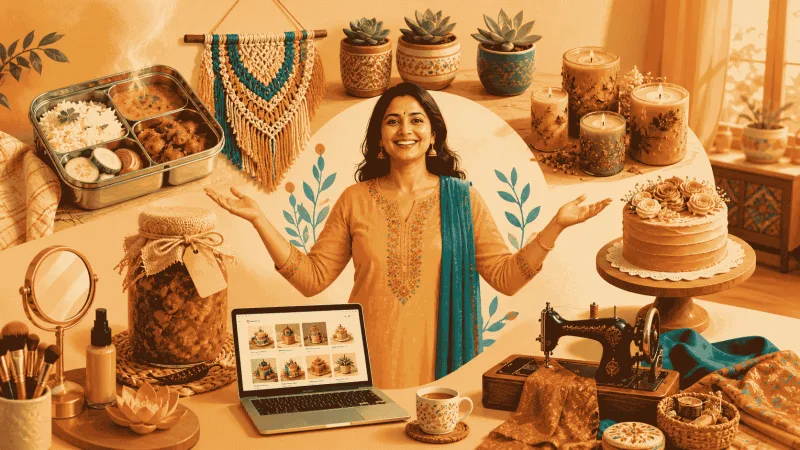
A no-fluff guide with real earnings data, legal requirements, government schemes, and practical steps you can act on today — written for every Indian who has ever thought, “I have a skill, but I don’t know where to start.”
First, the truth that most blogs won’t tell you
There are hundreds of articles online listing “business ideas from home.” Most of them give you vague ideas like “start a YouTube channel” or “sell on Amazon” without telling you how much you will realistically earn in month 3, what the legal requirements actually are, or how to get your first customer without spending on ads.
This guide is different. Every idea here is backed by real data from May 2026, real earnings from real Indian home sellers, actual government rules, and an honest assessment of what it takes. No shortcuts, no hype.
One more thing: you do not need a business degree, a large kitchen, or a CA to start. You need a skill (or the willingness to learn one), a smartphone, and the discipline to show up for 90 days.
Let’s begin.
1. Home Tiffin Service — The Most Underrated ₹2 Lakh/Month Business
India has a massive, permanent demand problem that no app has fully solved: millions of working professionals, students in paying guest accommodations, and bachelors who want fresh, homemade food every single day — and most of them are eating substandard food from dhabas or overpriced restaurant apps because there is no trusted home cook nearby. That gap is your business.
The real numbers (May 2026)
A typical home tiffin service in a mid-sized Indian city works like this:
- Food cost per meal: ₹40–60
- Packaging + delivery per meal: ₹15–35
- Total cost per meal: ₹66–115
- Selling price: ₹100–180 per meal
- Profit margin: 45–60%
At 25 customers paying ₹3,500/month for a monthly lunch subscription (26 working days), your monthly revenue is ₹87,500 with a net profit of approximately ₹45,000–55,000. That is with 25 customers — which most determined sellers reach within 3–4 months.
A homemaker in Hyderabad named Risika started with 10 meals a day and scaled to 60 within three months, earning ₹70,000 net per month. Another seller documented in a 2025 case study grew from 8 customers to 85 over 20 months and now clears ₹2 lakh per month. These are not outliers — they are the realistic ceiling for a well-run home tiffin business.
Legal requirements you must know
This is the part most guides skip. Selling home-cooked food commercially without FSSAI registration is illegal and can result in fines up to ₹5 lakh. Here is what you need:
- FSSAI Basic Registration — mandatory for any food business with annual turnover up to ₹1.5 crore (threshold revised upward from April 1, 2026, by FSSAI order dated March 13, 2026). Cost: ₹100 per year. New registrations issued from April 2026 now come with perpetual validity — no annual renewal needed.
- Apply online at foscos.fssai.gov.in. You will need: a passport-size photo, Aadhaar or PAN, your home address proof (electricity bill works), a list of food items you will make, and a simple hand-drawn layout of your kitchen. Approval typically takes 7–15 working days.
- GST Registration: Not required unless your annual turnover crosses ₹40 lakh. Most home tiffin businesses will not hit this for years.
- Your home address is your registered kitchen. You do not need a commercial premise.
How to get your first 15 customers
- Survey your neighbourhood. Ask in your apartment’s WhatsApp group: “Any bachelors or working professionals looking for healthy home lunch?” You will be surprised how many respond.
- Offer a 3-day free trial to 5 people. If your food is good, at least 3 will convert to paying subscribers.
- Partner with a local PG owner or office building security. A single PG with 20 residents is your business kickstarted.
- Post your menu with photos on a Paasho store link and share it in colony Facebook and WhatsApp groups weekly.
One thing that will set you apart
Consistency is your USP, not taste. Every great home tiffin business succeeds because the food arrives at the same time, every day, and tastes the same every week. Customers will pay more for predictability than for great food that arrives late.
2. Homemade Snacks, Pickles, Baked Goods — From ₹5,000 to ₹4 Crore (It Has Happened)
This is not a motivational exaggeration. Patil Kaki from Mumbai started making Maharashtrian snacks — chakli, chivda, karanji — with a ₹5,000 investment from her home kitchen. Today, her business crosses ₹4 crore annually and serves 18,000+ customers. Her key tool? A proper online presence and word-of-mouth in the early days.
In Guwahati, a woman named Sunita built “Kitchen & Gupshup” to ₹30 lakh annual revenue selling artisanal sweets and snacks — with zero external investment and no advertising spend. Pure Instagram and WhatsApp marketing.
These are real businesses. And they started exactly where you are.
What sells best in 2026
Based on demand across Indian home food platforms and social commerce:
- Pickles and achaar — especially regional varieties (Andhra avakaya, Rajasthani ker sangri, Punjabi mixed achaar). Massive demand from the diaspora within cities.
- Festival hampers — Diwali dry snack boxes, Holi thandai kits, Eid special packs. Festival seasons can triple your revenue in a single month.
- Healthy snacks — millet-based laddoos, roasted makhana mixes, ragi cookies. This category is growing fastest because it sits at the intersection of homemade + healthy + gifting.
- Baked goods — custom cakes, eggless options, and subscription brownie boxes. Instagram-friendly products photograph beautifully and sell themselves.
Pricing tip that most home sellers get wrong
Never price based on what feels fair. Price using this formula:
Selling Price = (Raw material cost + Packaging cost + Your time cost + Electricity/gas cost) × 2.5 to 3
If a 500g box of mixed snacks costs you ₹120 to make (including 2 hours of your time valued at ₹50/hour), it should sell for ₹300–360. Most home sellers undercharge because they do not count their own labour as a cost. Your time has value.
Packaging is not optional
In 2026, buyers order what looks good before they taste it. A ₹200 investment in printed kraft boxes, stickers, or a simple branded label makes the difference between someone sharing your product on Instagram and someone who just eats it and forgets. Good packaging is marketing.
Legal requirement: same as tiffin service
FSSAI Basic Registration (₹100/year, perpetual validity from April 2026). Display your 14-digit FSSAI number on all packaging. That is it to start legally.
3. Online Tutoring / Home Tuition — India’s $4 Billion Market That Rewards Individual Teachers
India’s private tutoring market was valued at USD 4.1 billion in 2024 and is growing at 7.5% annually. But here is what the market data does not tell you: the biggest beneficiaries of this growth are not Vedantu or Unacademy — they are individual teachers who build their own student base, charge their own rates, and keep 100% of the fee.
What you can realistically earn (May 2026 data)
Hourly rates by experience level:
- Beginner (0–1 year): ₹300–500/hour
- Intermediate (1–3 years): ₹500–800/hour
- Experienced (3+ years): ₹800–1,500/hour
- Specialist (JEE/NEET/CUET): ₹1,500–3,000/hour
At ₹500/session, 12 sessions per student per month, with just 10 students: you earn ₹60,000/month. That is working roughly 3–4 hours a day. At 20 students, you are at ₹1.2 lakh.
The highest-paying subjects in India right now
- JEE Physics and Chemistry (Rajasthan, Delhi, Maharashtra): ₹1,200–3,000/hour
- NEET Biology and Chemistry (Tamil Nadu, Karnataka, Andhra Pradesh): ₹800–2,000/hour
- CUET preparation (pan-India, rising fast since 2022): ₹600–1,200/hour
- Spoken English (tier 2 and 3 cities): ₹400–800/hour, massive unmet demand
- IELTS/OET coaching (Kerala, especially for nurses): ₹700–1,500/hour
- Coding for kids (grades 6–10): ₹500–1,000/hour
How to start without a platform fee
- Start with Superprof India — 0% commission. You set your own rate. Create a profile today at superprof.co.in.
- Leverage your colony and school networks. One student who gets results will refer two more. Word of mouth is the most powerful acquisition channel for tutors.
- Conduct a free trial class via Zoom or Google Meet. Record it (with permission) and share the clip on Instagram Reels. Parents search for tutors on Instagram far more than you think.
- Set up a Paasho store listing your subject, grades, batch timings, and monthly fee. Share this link whenever anyone asks about your classes. It looks far more professional than a WhatsApp message.
The one thing that builds a waiting list
Results. Not certificates, not platforms, not fancy tools. If one student’s marks improve by 20 points, their parent will tell five other parents. Build your first batch with everything you have, and the second batch fills itself.
4. Reselling on Meesho — The Only Business That Genuinely Requires Zero Rupees to Start
Most “zero investment” businesses are not actually zero investment. Meesho reselling is the real exception. You need: a smartphone, a Meesho app (free), and a bank account or UPI ID. That is it. No inventory, no shipping, no GST, no warehouse.
How it works (simply)
- Download the Meesho app and register with your mobile number.
- Browse the catalogue. Add your profit margin (you decide — typically ₹50–300 per item) on top of Meesho’s supplier price.
- Share the product image with your price on WhatsApp status, Instagram Stories, Facebook Marketplace, or local colony groups.
- When a customer wants to buy, you place the order on Meesho using the customer’s address. Meesho ships directly to them.
- Your profit is credited to your bank account weekly.
You never handle the product. You never pack anything. You never visit a courier. You are a connector, and you earn for it.
Realistic earnings (not the inflated YouTube version)
- Beginner (1–2 hours/day): ₹6,000–9,000/month
- Consistent (3 hours/day): ₹20,000/month
- Scaled (multiple WhatsApp groups, Instagram following): ₹50,000+/month
As of Q3 FY2026, Meesho had 846,000 active transacting sellers, growing 81% year-on-year. The platform is not saturated — it is expanding into tier 3 and tier 4 cities where most people have not tried it yet.
What to sell for the best results
- Women’s ethnic wear (kurtis, sarees): highest volume, ₹100–300 margin per piece
- Home and kitchen organizers: steady year-round sales, very low return rates
- Skincare and personal care: repeat buyers once they trust the product
- Kids’ accessories and stationery: school season spikes (June–July, January)
The one insight that changes everything
Most new Meesho resellers share products to a WhatsApp group of 30 friends and family and then give up after two weeks. The sellers who scale build buyer communities — WhatsApp groups of 200–500 people who have already bought from them, organized by interest (e.g., “Kurtis and Ethnic Wear”, “Home Decor Deals”). Treat your list like a community, not a broadcast channel. Share 3–5 products a day with genuine commentary (“This kurta runs slightly large, order one size down”) and you will build trust faster than any ad can.
When do you need GST?
Only when your annual turnover as a reseller exceeds ₹40 lakh (₹20 lakh in special category states). For a beginner earning ₹10,000–20,000/month, you are nowhere near this. Start without worrying about it.
5. Handmade Products — Jewellery, Macramé, Candles, Crochet — The Business That Finds Its Own Buyers
In a world flooded with mass-produced products, handmade is a differentiator. Buyers on Instagram, Etsy, and craft fairs are actively looking for things that are unique, personal, and carry a story. If you make something with your hands, you already have the hardest part.
What is selling in 2026
- Macramé wall hangings and plant hangers: Pooja ki Potli (Delhi) started with ₹5,000 and now earns ₹30 lakh annually. She now employs 25 women.
- Crochet bags and accessories: Stushè, a handmade crochet brand, crossed ₹1 crore in D2C revenue in under 12 months (2026) using 50 women artisans.
- Hand-poured soy and coconut wax candles: profit margins of 150–200% are achievable. A candle that costs ₹80 to make (wax + wick + fragrance + jar) sells for ₹200–350 with ease.
- Handmade jewellery (oxidised, terracotta, fabric, resin): Aboli Jewellery (Maharashtra) built a community-driven brand from home with no minimum order values and ships pan-India.
- Personalised gifts and name plates: Enormous demand around weddings, birthdays, and housewarmings. High margins, gift-ready packaging.
Where to sell
- Instagram and Paasho store link in bio: For Indian buyers. Reels of your making process outperform product photos by 5x in reach.
- Meesho (as a supplier, not reseller): List your handmade products and let the Meesho reseller network sell on your behalf. 0% commission.
- Etsy: For global reach. Indian ethnic and handmade products have a strong audience abroad. Shobitam (Indian ethnic wear) crossed ₹9 crore in 2 years starting from Etsy.
- Local exhibitions and craft fairs: Do not underestimate offline. One well-attended local fair can get you 20 regular customers who return online.
The truth about “starting small”
Most successful handmade sellers started with a ₹2,000–5,000 supply purchase, made 15–20 items, photographed them on a white bedsheet by a window (natural light is your best photographer), and posted daily on Instagram for 30 days. The sellers who quit do so in week three. The sellers who succeed are still posting in week six when the first organic enquiry arrives.
6. Home Beauty Parlour / Salon Services — ₹50,000–₹1 Lakh/Month From Your Living Room
India’s professional beauty services market is growing at 8.5% annually and is projected to reach USD 23.3 million by 2030. And the biggest opportunity is not in mall salons — it is in trusted home-based services that women in residential areas prefer for convenience, privacy, and hygiene.
Why this works in 2026
Post-2020, a permanent shift happened: women prefer beauty services that come to them, or happen in a private, clean home setting rather than a crowded public salon. If you have the skills, your living room is your salon.
Start-up investment
- Minimal setup: ₹50,000–80,000 (chair, mirrors, basic tools, starter product kit)
- Standard setup: ₹1–2 lakh
- Break-even: typically 3–6 months
Services that earn the most per hour in a home salon
- Pre-bridal packages: ₹10,000–30,000 per booking
- Keratin / hair smoothening: ₹1,500–4,000 per session
- Facials and cleanup: ₹500–1,200 per session (repeat monthly)
- HD brows and lash services: ₹400–800 per session
- Basic hair cut and styling: ₹300–600 (high volume)
Legal requirements
- Trade License: From your local municipal corporation. Cost varies by city (typically ₹500–2,000/year).
- Shop & Establishment registration: Required in most states within 30 days of starting. Apply at your state labour department.
- Udyam (MSME) Registration: Free, online at udyamregistration.gov.in. Unlocks government loans and subsidies.
- GST: Only if turnover exceeds ₹20 lakh/year for services.
- Housing society NOC: Get written permission from your RWA or building society before starting. This avoids disputes.
How to get clients in the first 30 days
- Offer 50% discount for the first 10 customers. Call them friends, not discount customers. Ask for a Google review and a WhatsApp referral.
- Create a Google Business profile for your home salon (yes, home addresses are allowed). Women in your area actively search “parlour near me” — you want to appear.
- Partner with a bridal wear shop or lehenga rental nearby. When their customer needs a makeup artist for a function, they will refer you.
7. Tailoring and Boutique from Home — The Craft India Never Stopped Needing
With the rise of fast fashion, there is a strong counter-movement: women who want custom-stitched salwar suits, blouses, and party wear that fit them perfectly. A skilled home tailor is almost impossible to find in most residential areas — which means if you are one, you have a monopoly on your colony.
Earnings potential
- Salwar suit stitching: ₹400–800 per set
- Saree blouse: ₹200–500 per blouse
- Lehenga (custom): ₹2,000–8,000 depending on work
- Alteration work: ₹100–300 per piece, high volume possible
- A dedicated home tailor with 15–20 active customers can earn ₹20,000–60,000/month
How to scale beyond stitching
The best home tailors do not just stitch — they become a boutique. They source fabric from wholesale markets (Surat, Chandni Chowk, Bhuleshwar), make readymade pieces or unstitched sets, and sell them online. Once you have a Paasho store link and an Instagram profile with photos of your work, you can take orders from across your city — not just your building.
If you are new to tailoring, the National Institute of Fashion Technology (NIFT) extension centres and state government Industrial Training Institutes (ITIs) offer affordable tailoring and garment-making courses, many of them subsidised for women.
PMEGP funding is available for this
Tailoring and boutique work falls under the service sector for PMEGP eligibility. Women applicants can get a 25% subsidy (urban) to 35% subsidy (rural) on project costs up to ₹20 lakh. This means the government funds a significant portion of your machine, furniture, and setup cost. See the government schemes section at the end of this article.
8. Content Writing and Social Media Management — Skills That Pay ₹20,000–₹1 Lakh/Month From a Laptop
If you can write well in English or Hindi, or if you understand how Instagram and Facebook work from a marketing perspective, you already have a skill that hundreds of small Indian businesses will pay for every month.
The market reality in 2026
Every small business in India — from a dental clinic to a clothing brand to a restaurant — knows it needs to be on Instagram and needs to be found on Google. Most of them have no idea how. They are looking for someone to manage this for them. That someone can be you.
What you can earn
- Freelance content writing (blogs, website copy): ₹2–5 per word for beginners, ₹8–15 per word at intermediate level. A 1,000-word blog earns ₹2,000–15,000.
- Social media management (managing Instagram + Facebook for one business): ₹5,000–15,000 per client per month. With 5 clients, you earn ₹25,000–75,000/month.
- SEO content writing: ₹3,000–8,000 per article at beginner level; higher with experience.
How to land your first client without experience
- Pick one local business you like (a restaurant, a boutique, a coaching class). Offer to manage their Instagram for free for one month. Document the growth (even if small).
- Create a portfolio of 5–10 sample posts or blog articles. Even fictional ones for imaginary businesses count as portfolio work.
- Register on Fiverr and Upwork. Start with competitive rates. Your first 3–5 reviews matter more than your skill level.
- Join “content writing jobs India” groups on LinkedIn and Facebook. These communities post paid opportunities daily.
One overlooked niche with huge demand
Regional language content — social media posts and blogs in Hindi, Tamil, Marathi, Kannada, Telugu, and Bengali. There are very few skilled creators who can write marketing content in these languages, and demand from brands targeting regional markets is enormous. If you are fluent in any Indian language beyond English, this is your edge.
9. Selling Plants from Home — The Business That Grew Quietly and Is Now Blooming
The indoor plant market in India exploded post-2020 as millions of people started spending more time at home and began decorating with plants. That demand did not go away — it matured into a permanent lifestyle choice. And the beautiful thing about a home plant business is that your inventory literally reproduces itself.
How it works
You start with a few mother plants — money plants, snake plants, pothos, succulents, or more specialist varieties like monsteras, aroids, or aglaonemas. You propagate them (a process that costs nothing — just water and time), pot them, grow them to a sellable size, and sell. Your inventory multiplies without you spending more.
What sells and at what price
- Money plant and pothos (common varieties): ₹50–150 per pot, very easy to propagate
- Snake plant (Sansevieria): ₹150–400 depending on size
- Rare monsteras and aroids: ₹500–3,000 per plant, high collector demand
- Succulent arrangements: ₹200–600 for a curated pot, excellent gifting product
- Gardening kits (seeds + soil + pot + instruction card): ₹250–600 per kit, strong gifting demand
Where to sell
- Local WhatsApp and Facebook colony groups
- Instagram (plant communities are deeply engaged — hashtags like #IndoorPlantIndia have hundreds of thousands of followers)
- Your Paasho store link (buyers can browse your available stock and place orders via WhatsApp)
- Local plant swaps and exhibitions — these have an active community in every major Indian city
The honest challenge
Shipping live plants is tricky. Start by selling locally and doing hand-delivery or pickup. Once you understand plant care during transport, you can expand to nearby cities. Many successful home plant sellers partner with a local courier who knows how to handle fragile shipments.
10. How to Turn Any of the Above Into a Real Online Business — For Free
Here is the thing no one tells you clearly: having a skill or a product is only half the business. The other half is how customers find you, browse what you offer, and place an order. For most home sellers, this still happens through chaotic WhatsApp conversations — photos sent one by one, prices typed repeatedly, addresses collected in chat threads, confusion about what is still available.
There is a better way, and it costs nothing.
What a proper store link changes
Paasho.com lets you create a free online store in under 5 minutes — no app download needed for your buyer, no commission, no subscription, no GST or business registration required to start. You get:
- A custom store link (e.g., paasho.com/yourname) you can share anywhere
- A clean product catalogue with photos, descriptions, and prices
- One-tap ordering: buyers click “Order” and a pre-filled WhatsApp message goes to you with their item, quantity, address, and payment preference — no back-and-forth
- Analytics: see which products get the most views and which convert
- Local discovery so buyers nearby can find you organically
Whether you are selling tiffin subscriptions, handmade candles, tutoring batches, or 10 varieties of pickle, your Paasho store link is the most professional thing you can share. Put it in your Instagram bio, your WhatsApp status, your Facebook profile. Every click is a potential customer.
Set it up today: paasho.com — pick your name, add your products or services and go live. It takes 5 minutes and zero rupees.
Government Schemes Every Indian Home Seller Should Know in 2026
Most home-based sellers do not know these exist. That is a costly mistake, because some of these schemes can fund a significant portion of your startup costs.
1. PMEGP — Prime Minister’s Employment Generation Programme
- What it is: A credit-linked subsidy scheme from the Ministry of MSME for new micro-enterprises.
- Who can apply: Any individual above 18 years with at least 8th standard education (for projects above ₹5 lakh in the service sector).
- Subsidy rates: 15% for general urban applicants, 25% for general rural applicants, 25% for women in urban areas, 35% for women in rural areas. Your own contribution is just 5% of the project cost.
- Project cost limit: Up to ₹20 lakh for service/business enterprises (which covers tiffin services, tailoring boutiques, beauty parlours, handmade product businesses).
- How to apply: Online at kviconline.gov.in/pmegpeportal. Free to apply. No middlemen needed.
- Important note: The scheme’s current approval runs through FY 2025–26. Apply as soon as possible and watch for announcements about the next phase.
2. MUDRA Loan (PM SVANidhi for micro-sellers)
- Collateral-free loans up to ₹10 lakh for micro-businesses.
- Three tiers: Shishu (up to ₹50,000), Kishor (₹50,000–5 lakh), Tarun (₹5–10 lakh).
- Apply at any PSU bank or via the Udyami Mitra portal (udyamimitra.in).
3. Udyam Registration (Free, Online, Takes 10 Minutes)
- Register your home business as an MSME at udyamregistration.gov.in.
- Completely free. Uses your Aadhaar and PAN.
- Once registered, you are eligible for priority bank lending, government subsidies, collateral-free loans, and market linkage programmes.
- There is no minimum turnover to register. Even if you earn ₹5,000/month, you can register as an MSME.
4. Stand-Up India
- Bank loans between ₹10 lakh and ₹1 crore for SC/ST and women entrepreneurs setting up greenfield enterprises.
- At least one woman borrower and one SC/ST borrower per bank branch must be supported.
- Apply at standupmitra.in
The most important thing about government schemes
You do not need a consultant to apply for PMEGP or Udyam registration. Both are free, online processes. If someone charges you to apply on your behalf, it is legal but optional — and often unnecessary. Read the official portal instructions, or watch a recent YouTube tutorial from a verified source before paying anyone.
The One Thing That Separates People Who Earn From Home and People Who Only Dream About It
After all the research, all the case studies, all the data — here is what actually separates a Patil Kaki (₹4 crore from ₹5,000) from someone who had the same idea and gave up:
They did not wait until everything was perfect.
Patil Kaki did not wait for a commercial kitchen. She used her home kitchen. Pooja ki Potli did not wait for a perfect website. She posted on Instagram with her phone camera. The tiffin seller in Hyderabad did not wait for 20 customers before starting. She cooked for 10 and delivered herself.
The secret is embarrassingly simple: start small, start imperfect, start today. Make your first product. Cook your first tiffin. List your first three products on a Paasho store. Share the link with 10 people and ask honestly, “Would you pay for this?”
The market will tell you what to improve. But it can only do that once you have started.
Frequently Asked Questions
Can I start a food business from home in India without a commercial kitchen?
Yes. Under FSSAI Basic Registration (for annual turnover up to ₹1.5 crore as of April 1, 2026), your home kitchen qualifies as the registered food preparation premises. You do not need a separate commercial kitchen to legally operate a tiffin service, bakery, or pickle-making business from home. Apply at foscos.fssai.gov.in.
Do I need GST registration to start a home business in India?
No. GST registration is mandatory only if your annual turnover exceeds ₹40 lakh (₹20 lakh in special category states like Manipur, Meghalaya, etc.). For most home-based beginners, GST is not required at all. You can start and operate legally without it.
Which home business is most profitable in India in 2026?
It depends on your skill set. Tiffin services offer 45–60% profit margins and can generate ₹60,000–2 lakh/month at scale. Online tutoring for JEE/NEET earns ₹1,500–3,000 per hour. Handmade products and reselling via Meesho can grow from ₹6,000/month to ₹50,000+ with consistency.
What government schemes are available for home-based businesses in India?
The PMEGP scheme offers 25–35% subsidies (higher for women) on projects up to ₹20 lakh in the service sector. MUDRA loans provide collateral-free credit up to ₹10 lakh. Udyam registration (free) gives access to all MSME benefits. Stand-Up India supports SC/ST and women entrepreneurs with loans up to ₹1 crore.
Do I need a website or app to start selling online from home?
No. A free Paasho store (paasho.com) gives you a professional storefront with a shareable link, product catalogue, and WhatsApp-integrated ordering in 5 minutes. No coding, no monthly fee, no commission. You do not need a website or an app to start.
How do I get my first customers for a home business in India?
Start with your warm network. Tell 50 people — family, friends, neighbours, former colleagues — what you are doing. Post in local WhatsApp and Facebook groups. Share your Paasho store link on Instagram and WhatsApp status. Offer a first-order discount or free trial. Consistency for 30–60 days is what separates successful home sellers from those who quit too soon.
Is Meesho reselling still worth starting in 2026?
Yes. Meesho had 846,000 active transacting sellers as of Q3 FY2026 — growing 81% year-on-year. The platform is expanding into tier 3 and tier 4 cities. Reselling requires zero investment and is a legitimate income source. Beginners earn ₹6,000–9,000/month with 1–2 hours/day effort; consistent sellers with buyer communities earn ₹50,000+/month.
What is the FSSAI registration fee for a home food business in 2026?
₹100 per year under Basic Registration (turnover up to ₹1.5 crore). As of April 1, 2026, new registrations come with perpetual validity — no annual renewal needed. Apply at foscos.fssai.gov.in. Processing time: 7–15 working days.
Final Word
India is one of the most remarkable countries in the world to start a home business. The infrastructure has never been better — cheap data, UPI payments, WhatsApp for commerce, government subsidies for small businesses, and platforms like Paasho that let you go live in 5 minutes for free. The only thing between you and your first ₹10,000 month is the decision to start.
Pick one idea from this list. The one that matches what you already know or what you love. Spend this weekend setting up a free Paasho store and sharing your first product or service with 20 people. See what happens.
The worst case: nothing happens and you learn. The best case: it becomes everything.