Blog/WhatsApp Business vs. Your Own Store Link: Why Smart Indian Home Sellers Are Switching in 2026
WhatsApp Business vs. Your Own Store Link: Why Smart Indian Home Sellers Are Switching in 2026
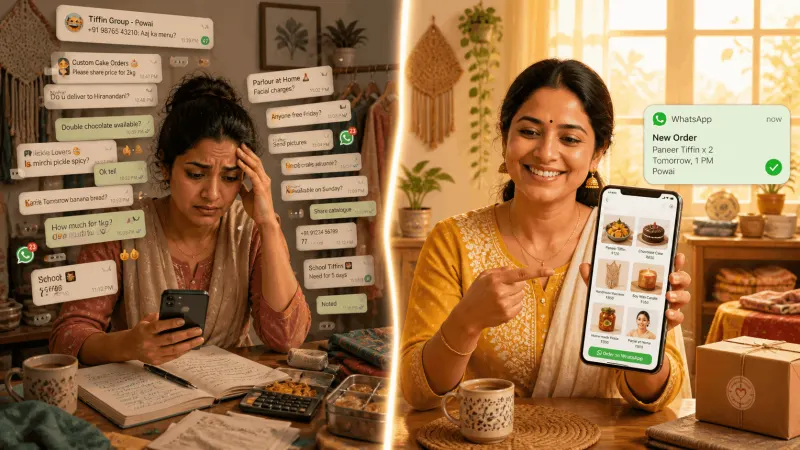
You already use WhatsApp to run your home business. But there is a good chance it is quietly costing you orders, customers, and credibility — every single day. Here is what the data says, and what to do about it.
Let us start with a number that should alarm every home seller in India
In March 2026 alone, WhatsApp banned 59.78 lakh accounts in India. Not bots. Not scam operations. Mostly regular people and small business owners who were using WhatsApp the way they always had — sending product photos to groups, promoting their business to contacts, following up on orders.
One seller on Reddit’s r/StartUpIndia described it plainly: “WhatsApp banned my small business account for a day — lost all orders. My entire day’s business just disappeared. No warning, no appeal that worked in time.”
This is not a fringe story. It is the unavoidable reality of building your entire home business on a platform you do not own, cannot control, and can lose access to overnight.
But bans are only one part of a much larger problem. Before we talk about solutions, let us be honest about what running a business on WhatsApp actually looks like at scale — because most articles skip this part entirely.
The Real WhatsApp Business Experience — Honest, Not Promotional
WhatsApp is genuinely brilliant for home sellers in the early days. You already have it. Your customers already have it. You can send a photo, get a reply, take a UPI payment, and deliver the product — all in one thread. For your first 15–20 customers, it works beautifully.
The numbers back this up: India has 535–550 million monthly active WhatsApp users as of 2026 — the largest WhatsApp market in the world. There are 15–25 million WhatsApp Business accounts in India, growing at over 35% year-on-year. 78% of Indian small businesses use WhatsApp for some form of business communication. 72% of product discovery in India happens on WhatsApp. The platform is extraordinary at getting people into conversations.
Here is the problem: a conversation is not a system.
When you have 10 customers, managing orders through WhatsApp is manageable. When you have 50, it becomes stressful. When you have 100, you are losing orders you do not even know you are losing. A LinkedIn post from April 2026 summed it up this way: “Most WhatsApp sellers are losing 50–100 orders daily — not because of demand, but because of chaos. They post product photos, customers reply… and things fall through the cracks.”
That chaos is what this article is really about.
7 Specific Problems WhatsApp Creates as Your Home Business Grows
Problem 1: The 256-Contact Broadcast Wall
The WhatsApp Business app allows you to send a broadcast — a one-to-many message — to a maximum of 256 contacts per list. This limit has not changed in 2026. If you have 400 customers, you have to manually create multiple lists, send separately, and track who got what. More critically, your broadcast message only reaches contacts who have saved your number. Anyone who has not saved you — which is most casual buyers — simply does not receive it.
This means every Diwali offer, every new menu update, every restocking announcement reaches a fraction of your actual customer base. You are running your business on a leaky pipe.
Problem 2: Your Most Important Business Asset Can Vanish Overnight
This deserves its own section because it is genuinely existential. WhatsApp banned 59.78 lakh Indian accounts in March 2026. In February 2025, 9.7 million Indian accounts were banned. These bans are triggered by seemingly normal seller activity:
- Sending promotional messages to people who have not explicitly opted in
- Too many users blocking or reporting your messages as spam (competitors have been known to orchestrate this)
- Using any unofficial tool to manage bulk messaging
- Being flagged during WhatsApp’s increasingly aggressive AI-driven scam crackdowns
A temporary ban locks you out for 1–7 days. A permanent ban erases your business number, your chat history, your customer list, and every order record in it. Appeal processes exist but take 3–7 days minimum, and permanent bans have very limited recourse. Your entire business — customers, orders, receipts, everything — lives in a platform you do not own and can lose without warning.
Compare that to a dedicated store link. No one can ban your store. No algorithm decides whether your menu update reaches your customers. Your product catalogue, order records, and store URL belong to you.
Problem 3: Order Chaos Is Not a Sign You Are Doing Something Wrong — It Is Baked Into the Format
Here is what a typical order flow looks like for a home tiffin seller, baker, or handmade product seller on WhatsApp:
- Customer asks “what is available today?” in the group chat
- You share a photo or voice note with the menu
- Customer replies “I want 2 boxes of the biryani” — but the message is buried under 14 other replies from other group members
- You miss the message in the flood
- Customer assumes you saw it and expects delivery
- You do not deliver because you did not see the order
- Customer is frustrated
This scenario plays out hundreds of times every week across India’s home seller ecosystem. The problem is structural: WhatsApp groups are designed for conversation, not for commerce. Orders, replies, memes, emojis, “okay noted”, price queries, complaints — they all look the same in a chat thread. There is no way to separate confirmed orders from casual interest. There is no order status. There is no reference number. There is no paper trail unless you manually create one.
A developer in Bangalore described building an order manager specifically for this because “the manual mess is costing small businesses real money every day.” That tool exists because the problem is widespread enough to build a startup around it.
Problem 4: Chasing Payments Is Killing Your Reputation
One of the most commonly reported pain points in home seller communities — documented in Bangalore residential WhatsApp group analyses and seller community forums — is payment follow-up. You have delivered the food. You have packed and shipped the product. Now you must send a follow-up message asking for payment, then a polite reminder, then a firmer reminder. The buyer feels pestered. You feel uncomfortable. The transaction ends on an awkward note that no amount of great product quality can fix.
This happens because WhatsApp has no native payment-at-checkout mechanism tied to specific orders. WhatsApp Pay exists, but it requires a manual transfer that is disconnected from the order. There is no “pay now” button attached to a confirmed item list. Payment is always a separate, manual, socially awkward step.
Problem 5: You Look Like a Side Hustle, Not a Business
This one is harder to quantify, but sellers who have moved to a dedicated store link report it consistently: buyers behave differently when they see a proper product page versus a photo in a WhatsApp chat.
When a customer receives a photo of your handmade candles in a WhatsApp message with a price typed below it, their brain says “side hustle.” When they click a link and see a clean page with product names, photos, descriptions, and a price — their brain says “business.” The trust signal is different. The willingness to pay is different. The likelihood they save your number and return is different.
There is research to support this beyond intuition: dedicated store links with proper product pages show 30–50% higher conversion rates than direct chat-based selling for the same product, according to link-in-bio tool analytics reports. A fashion retailer who switched to a bio link store reported 200% revenue growth in three months. The product did not change. The presentation did.
Problem 6: There Is No Analytics — You Are Flying Blind
The WhatsApp Business app gives you delivery receipts and read receipts. That is it. You cannot see:
- Which product people looked at most but did not buy
- What time of day your messages get the most engagement
- How many unique people viewed your catalogue
- Where your customers are coming from (Instagram? A referral? A Google search?)
- Which promotions drove actual orders versus just curiosity
Running a business without this data means every decision you make — what to stock, what to promote, how to price — is based on gut feeling alone. Good sellers compensate for this with sharp intuition. But intuition is not scalable, and it cannot tell you what a first-time visitor was looking for before they quietly left your chat without buying.
Problem 7: Automation Starts and Ends at “Good Morning”
The WhatsApp Business app offers three automated messages: a greeting message (sent when someone first contacts you), an away message (sent outside your business hours), and quick replies (shortcuts to pre-written responses). That is genuinely all.
There is no automated order confirmation. No automatic “your item is ready for pickup” update. No follow-up message 7 days after purchase asking for a review. No abandoned cart recovery. No smart reply that says “You ordered biryani last Tuesday — would you like the same today?”
The WhatsApp Business API (the paid, enterprise version) offers more automation, but it costs ₹0.44–₹0.75 per marketing conversation and requires setting up a Meta Business Manager account, a dedicated phone number, and integration with a third-party BSP provider. The monthly cost for even moderate usage (500 conversations) can reach ₹2,700+. That is not the tool for a home seller who is just finding her feet.
What a Proper Store Link Actually Does Differently
A store link is not a website. Let us be clear about that from the start, because “website” sounds expensive, slow to set up, and technical. A store link is simply a shareable URL that opens a clean, mobile-friendly product page where your customers can browse what you sell and place an order — without you having to send a single photo or explain a single price.
Here is what changes the moment you have one:
Your product catalogue is always up to date and always accessible
Instead of sending a menu photo every morning (which gets buried in chat), your customer has a link they can open anytime and see exactly what is available, at what price, with what description. If you sell out of something, you remove it. If you add a new item, you add it. The link stays the same. Your customers bookmark it. They share it with friends. It becomes the single source of truth for your business.
Orders arrive organised and complete, via WhatsApp
Here is the thing most people do not realise: a good store link does not remove WhatsApp from the equation. It improves it. When a customer places an order through a Paasho store, a pre-filled WhatsApp message is automatically sent to you with their name, the items they want, the quantity, their delivery address, and their payment preference — all neatly formatted in a single message.
No more piecing together orders from a 40-message thread. No more “sorry, which product did you want again?” No more missed orders buried under reaction emojis. The conversation still happens on WhatsApp — it just starts from a position of complete information.
You stop chasing payments
When a buyer goes through a store link, payment details and preferences are captured as part of the order. The transaction has a clear start and end. You are no longer the awkward collector who has to remind someone to pay for food they already ate three days ago.
You are discovered by new customers, not just existing ones
WhatsApp is a closed ecosystem. People can only find you if someone sends them your number or adds them to a group. A store link, by contrast, can be indexed on search engines. It can be shared on Instagram, Facebook, and Twitter in a way that looks professional and enticing. It can appear in local discovery on platforms like Paasho that actively connect nearby buyers with nearby sellers. Every time you share your store link, you are not just reaching your existing contacts — you are creating an entry point for people who have never heard of you.
You get data
Even a basic store analytics dashboard tells you things WhatsApp never can: how many people viewed your store today, which product got the most views, which items are sitting unbought, what your average order value is. This is not sophisticated business intelligence — it is the basic information you need to make smarter decisions about what to stock and how to promote it.
You build something that belongs to you
This is the deepest benefit and the hardest to put a price on. Your store link is yours. No platform can ban it, restrict its reach, or decide who sees it based on an engagement algorithm. Your customer list, your product catalogue, your order history — all of it lives on your terms, not on Meta’s terms. The 59.78 lakh accounts banned in March 2026 had no such backup. They started from zero. You do not have to.
This Is Not an Either/Or Choice — The Best Home Sellers Use Both
One of the most common misconceptions when sellers consider this switch is that they must choose: WhatsApp or a store link. This is a false choice, and it is worth addressing directly.
The smartest home sellers in India in 2026 use WhatsApp and a store link as a system, not substitutes:
- Discovery and promotion: Instagram Reels, WhatsApp status updates, and Facebook posts drive awareness. Every post includes your store link.
- Browsing and selection: Interested customers click your store link, browse your full catalogue at their own pace, and select what they want — without cluttering your DMs with “what do you have?”
- Ordering: The customer places the order through your store. A pre-filled WhatsApp message arrives in your inbox with complete details.
- Relationship and follow-up: You reply on WhatsApp to confirm, coordinate delivery, and build the personal connection that keeps customers loyal.
WhatsApp stays what it is best at: warm, personal, conversational. The store link handles the operational infrastructure that WhatsApp was never designed to provide. Together, they are significantly more powerful than either one alone.
Think of it this way: a physical store has a shopfront (so customers can find and browse it) and a phone or counter (so they can talk to the owner). The store link is your shopfront. WhatsApp is your counter. You need both.
How to Know When You Are Ready to Make the Switch
You do not need to wait for a crisis to make this change. But if you are wondering whether the time is right for you specifically, here are the honest signals:
You are ready if…
- You have ever missed an order because it got buried in a group chat
- You find yourself re-explaining your menu, price list, or product catalogue to multiple people every week
- You send the same product photos repeatedly to new customers who ask “what do you have?”
- You have chased a customer for payment more than once
- You have more than 20 regular buyers
- You want new customers who do not already know you personally
- You want to be taken seriously as a business, not a hobby
You might not need it yet if…
- You have fewer than 10 customers and know all of them personally
- Your business is still in testing phase and you are not sure what you are selling
- You are still figuring out your product, price, and demand
Even in the second case, setting up a store link costs nothing and takes 5 minutes. There is no real reason to wait. The question is not whether you need it, but whether you are using it actively.
How to Set Up Your Free Store Link on Paasho in 5 Minutes
Paasho is built specifically for India’s home sellers and micro-businesses. No commission, no subscription fee, no GST registration required, no app download needed for your buyers. Here is exactly how to go from zero to live:
Step 1: Choose your store name
Go to paasho.com. Pick a name for your store — this becomes your permanent link (e.g., paasho.com/yourname). Use your business name or your name. Keep it short and easy to type.
Step 2: Pick your category
Select whether you are in food, products, or services. This helps Paasho surface you to nearby buyers looking in your category.
Step 3: Add your area
Enter your locality or neighbourhood. This powers local discovery — so buyers in your area can find you organically without you paying for ads.
Step 4: Add your products or services
Add each item with a photo, name, description, and price. You can add AI-generated descriptions from your photos, which saves time if writing is not your strength. Add at least 5–8 items to make your store look complete.
Step 5: Go live and share your link
Your store is now live. Copy your Paasho link and do the following immediately:
- Put it in your Instagram bio
- Post it as a WhatsApp status with a line like: “Browse what I make and order directly — link below”
- Send it to your 10 most loyal customers and ask them to bookmark it
- Add it to your Facebook profile and any groups where you are an active member
You are done. From this point, every new customer who asks “what do you sell?” gets one response: your store link. Clean, professional, complete.
The one thing to do every week after setup
Update your store once a week. Add a new product. Change the photo on a slow-moving item. Update your seasonal special. This keeps your store fresh and gives you a reason to share the link again — “New items added this week” is one of the most clicked WhatsApp status updates for home sellers.
The Deeper Point: Own Your Business Infrastructure
There is a concept in business called platform dependency risk. It describes what happens when your entire livelihood sits on a platform you do not control. Instagram changes its algorithm and your reach drops 60% overnight. WhatsApp bans your account and you have no way to contact your customers. Zomato changes its commission structure and your margins evaporate.
Every Indian home seller who has been in business for more than a year has either experienced this personally or watched someone else experience it. The solution is not to abandon these platforms — they are genuinely powerful for discovery and communication. The solution is to own the core of your business: your product catalogue, your customer relationship, and your order flow.
A store link that belongs to you is the beginning of that ownership. It is a small step, and it is free. But it is the difference between a business that is built on rented ground and a business that stands on its own foundation.
WhatsApp will remain essential. But the sellers who are thriving in 2026 — the home bakers earning ₹80,000 a month, the tiffin services with 100+ daily customers, the handmade jewellery brands with customers across three cities — are the ones who used WhatsApp to start and a proper store link to scale.
Frequently Asked Questions
Is WhatsApp Business enough to run a home business in India?
For your first 10–20 customers, WhatsApp Business is sufficient and convenient. As you grow past that, the limitations become costly: a 256-contact broadcast cap, no structured order management, ban risk, no analytics, and no way for new customers to discover and browse your products. A dedicated store link solves all of these without replacing WhatsApp — the two work best together.
Can my WhatsApp Business account really get banned just for promoting my products?
Yes. WhatsApp banned 59.78 lakh Indian accounts in March 2026 and 9.7 million in February 2025. Common triggers include sending promotional messages to contacts who have not explicitly opted in, users blocking or reporting your messages as spam, and using any unofficial bulk messaging tool. A ban can be temporary (1–7 days) or permanent. Your entire customer communication history and order records go with it.
Does a store link mean I stop using WhatsApp for orders?
No. The best store links — including Paasho — are built to work with WhatsApp, not replace it. When a customer places an order through your Paasho store, a pre-filled WhatsApp message with complete order details is sent directly to you. You still manage the conversation, relationship, and delivery on WhatsApp. But the order arrives organised and complete, not buried in a group chat.
Does setting up a store link cost money?
A Paasho store is completely free. No monthly fee, no commission on orders, no subscription. You do not need a GST number or business registration to start. You need a name, a product to sell, and 5 minutes.
How do new customers find my Paasho store?
Through two routes: first, you share your store link actively on Instagram, WhatsApp, and Facebook — it becomes your permanent “what I sell” link that you send to anyone who asks. Second, Paasho’s local discovery feature surfaces your store to buyers searching in your area, so you can get customers you did not market to directly.
WhatsApp says I can have 500 products in my catalogue. Why do I still need a store link?
The WhatsApp catalogue shows products but does not solve the core problem: orders still arrive as manual chat messages, there is no organised order flow, payment is disconnected, analytics do not exist, and new customers cannot discover you through it. A store link creates a structured, shareable, discoverable product page with an organised order and payment flow that WhatsApp’s catalogue was simply not designed to provide.
I am not very good with technology. Can I still set this up?
Yes. Paasho is built for exactly this. If you can use WhatsApp, you can set up a Paasho store. The setup requires no coding, no technical knowledge, and no app download for your customers. Most sellers complete setup in under 5 minutes. If you can add a product photo and type a price, you are done.
What is the single biggest mistake home sellers make with WhatsApp?
Treating it as their only business infrastructure. WhatsApp is an extraordinary communication tool, but it is not an ordering system, a CRM, a product catalogue, a payment processor, or a discovery platform. Using it as all of these things simultaneously is what creates the chaos — missed orders, payment confusion, account ban risk — that limits so many home sellers from growing beyond a certain point.