Blog/How to Grow Your Home Business Online in India (And Actually Make More Sales)
How to Grow Your Home Business Online in India (And Actually Make More Sales)
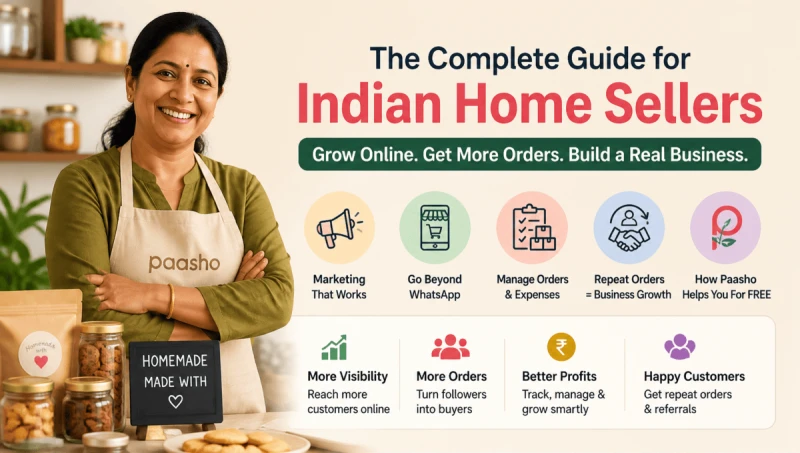
You've already done the hardest part. You started. You're making something people want: tiffins, cakes, handmade jewellery, beauty services, home-cooked pickles, online tuition. You have real customers who love what you do. But here's the uncomfortable truth that no one says out loud:
If your business only lives inside your WhatsApp, it's invisible to most of the world.
This guide is for every home seller in India who's ready to go from "WhatsApp only" to a real, growing online business, without spending money you don't have yet.
The WhatsApp Trap: Why Good Products Alone Won't Scale You
Let's be honest about WhatsApp for a second. It's a brilliant tool for conversations. It's a terrible tool for running a shop.
Here's what happens when you rely on WhatsApp groups alone:
Your menu gets buried under 47 other messages by lunchtime. A customer messages at 11 PM asking "bhaiya aaj kya hai?" and you're already asleep. Someone orders "the usual" but you have two customers who order "the usual" and they mean completely different things. You send the same PDF menu to 14 groups every Monday morning, and by Tuesday it's already scrolled away into the "Scroll of Doom," that bottomless pit of old messages where good orders go to die.
And it gets worse as you grow. When you're in the middle of preparing a Sunday catering order for 20 people, you cannot simultaneously reply to 15 new WhatsApp messages asking "price please?" This is what's known as Sales Fatigue, that state where your energy and patience drop as the day goes on, responses slow down, leads go cold, and orders that should have happened simply don't. In the digital world, speed is everything: studies show that responding to an inquiry within the first few minutes is the difference between a sale and a lost customer.
Running your home business purely on WhatsApp is like having a shop but keeping the shutters down. You only sell to the people patient enough to knock on a closed door. And every day the shutter stays down, there are buyers walking past who had no idea you existed.
The fix isn't complicated. But it does require one shift in thinking: your business needs a proper address on the internet, not just a chat thread.
The Opportunity Is Bigger Than You Think
Before we talk solutions, it's worth pausing on just how large the opportunity actually is.
In India today, 87% of consumers use "near me" searches every single week. Someone within three kilometres of your home is searching for exactly what you make, right now, on their phone. And 92% of Indian buyers say they trust a local business recommendation more than a national brand. That's a massive natural advantage for a home seller who can actually be found.
The catch? 75% of all clicks go to the top three results in any local search. If your business doesn't show up digitally, it simply doesn't exist for those buyers. You're not losing to a big company. You're losing to another home seller who took the time to set up a proper online presence.
This isn't a small niche market either. India has over 63 million micro and small enterprises, and the home-based segment is growing faster than almost any other part of the economy. The sellers winning right now aren't necessarily making better products than you. They've just made themselves findable.
What "Going Online" Actually Means for a Home Seller
"Going online" sounds expensive and technical. It doesn't have to be either.
Going online, for a home seller, means three simple things:
1. You have a place people can find you, not just people who are already in your groups, but strangers who are searching right now for exactly what you sell.
2. You have a way for customers to see everything you offer, clearly, with photos and prices, without needing to ask you every single time.
3. You have a system that handles the boring repeat work, so you're spending time cooking or making your product, not copy-pasting menus.
That's it. No complicated website. No app to build. No lakhs of rupees in ads. Just a proper, visible home for your business on the internet.
Meet Paasho: Your Free Storefront on the Internet
This is where Paasho comes in, and it's worth understanding what makes it different before anything else.
Paasho is a free platform built specifically for home sellers in India. In about five minutes, you get your own store page, something like paasho.com/your-name, with your products, photos, prices, and descriptions all in one clean place. Customers can browse it like they'd browse any online shop, and when they're ready to order, one tap sends you a pre-filled WhatsApp message with everything already filled in: items, quantities, delivery address, payment preference.
No app for your customer to download. No commission on your sales. No subscription fee. Completely free, forever.
Think of it like this: right now, your business is a stall in a narrow lane that only your regulars know about. Paasho is moving your stall to a busy market corner, with a proper signboard, a clean display, and a clear price list. You're still you, same food, same craft, same service, but now hundreds more people walking by can actually see you.
Here's what Paasho actually does for you:
Your own professional store page. No more sending PDFs or screenshots. Your catalogue lives online, always updated, always accessible. A customer can browse your full menu at 7 AM before they've had their chai, and place an order without waking you up. When a new buyer clicks your link instead of receiving a wall of WhatsApp photos, the immediate impression is: this is a real business. That trust signal matters enormously in the Indian market, where buyers are naturally cautious about unverified online sellers.
AI-written product descriptions. Snap a photo of your product. Paasho's AI writes a nice, professional description for it automatically. You can edit it if you like, but most sellers don't need to. This alone saves home bakers and craft sellers hours every week.
Pre-filled WhatsApp orders. When a customer clicks "Order on WhatsApp," the message that comes to you isn't a vague "hi." It has the product name, size, quantity, delivery address, and payment mode already written. No more confusion. No more back-and-forth to clarify a garbled voice note. Order accuracy goes from a coin-toss to near-certain.
Local discovery. Paasho lists your store for shoppers in your area searching by category or location. Someone in your neighbourhood searching for "tiffin service" or "home-made cake" can find you on Paasho without you spending a rupee on ads. This is the equivalent of being listed in the local market directory, except this directory is on the internet, open 24/7.
Shareable everywhere. Your Paasho link works anywhere: Instagram bio, Facebook post, WhatsApp status, LinkedIn profile, even a printed QR code on your packaging. One link, one neat little shop, works across all platforms.
Coupons and discount offers. Want to reward a regular customer or run a Diwali offer? Paasho lets you create coupon codes in minutes. No third-party app needed.
Simple analytics. Paasho shows you which products people are viewing most, how many people visited your store, and how orders are moving. It's like having a quiet assistant who tallies footfall while you focus on the cooking.
Here's how one home baker describes the change: before Paasho, she was sending her menu to 12 WhatsApp groups every day. People would message at odd hours asking what's available. After setting up her Paasho store, customers check her page and order directly. In her words: "I haven't paid a single rupee in commission."
The Three-Part Formula for More Sales From Home
A Paasho store is your foundation. But the sellers who really grow their business combine that foundation with three smart habits: wider reach, smarter marketing, and loyal repeat customers. Let's go through each one.
Part 1: Get Found by More People
The biggest missed opportunity for most home sellers isn't quality. Your food or product is probably already great. It's visibility. Most of your potential customers don't know you exist.
Here's how to fix that without paid advertising:
Set up your Google Business Profile (free). If you haven't done this yet, do it today. It's a free listing on Google that means when someone in your area searches "tiffin service near Koramangala" or "home tutor in Bandra," your business can show up in the results. The most important thing here is consistency: your name, address, and phone number should be identical everywhere they appear online. Ask your happy customers to leave a review on Google. Each review makes you more visible to the next stranger searching.
Use "near me" keywords in your Paasho store and social bios. When people search for food or services, they search with their neighbourhood in mind: "home chef in Powai," "organic tiffins in Indiranagar," "handmade jewellery Bandra." Include your area name naturally in your Paasho store description and your social media bios. This is free, takes two minutes, and can meaningfully affect whether you show up in local searches.
Think about how AI assistants recommend businesses. More and more, people are asking ChatGPT or Google Gemini "what's a good home-cooked tiffin service near HSR Layout?" and these AI tools surface businesses that have answered specific questions in their online content. If your Paasho description or Instagram caption answers a specific local question ("perfect for office lunches in Whitefield," "eggless custom cakes for first birthdays in Powai"), you increase the chance of being recommended by these tools. This is called GEO, Generative Engine Optimisation, and home sellers who start thinking about it now are ahead of the curve.
Use your Paasho link everywhere you already are. Put the link in your Instagram and Facebook bios. Share it as a WhatsApp status with a photo of your best-selling product. Print the QR code (Paasho generates this for you) on your packaging, your business card, the carry bag you hand over with every delivery. Every touchpoint is a chance for a new person to bookmark your shop.
The principle here is simple: the more places your store link appears, the more doors open to your business. Every new place your link shows up is like putting up another signboard in a different part of town.
Part 2: Market Your Business Like a Neighbourhood Champion
Big brands spend crores on marketing. You don't need to. The home seller's advantage is intimacy. You know your customers, your neighbourhood, your community. Here's how to use that.
Leverage your existing WhatsApp groups, but smarter. Don't abandon your groups; they're gold. But instead of sending a text menu that disappears, share your Paasho link with a single beautiful photo. "Check out today's menu 👆" with a link is more effective and less work than a long message nobody reads fully. And here's a specific tip: use WhatsApp Broadcast lists rather than groups for your best customers. Unlike group messages where everyone sees each other's replies and the chat turns into chaos, a broadcast delivers your message as a personal one-to-one message to each recipient. It feels personal, looks clean, and gets far better responses.
Post videos, not just photos. A photo is a product; a video is a story. Show the steam rising from the biryani pot, or your hands setting a stone into a piece of jewellery. Use local hashtags like #BandraEats, #IndiranagarFoodie, and #DelhiArtisans to reach the people who can actually order from you today. Always end with a clear call to action directing people to your Paasho link. The reel creates desire. The store link closes the sale.
Use festive moments as sales triggers. India has more festivals than almost any country on earth, and every one is an opportunity. Diwali gift boxes, Eid specials, Pongal sweets, Holi colours, Christmas hampers: plan your catalogue updates and Paasho coupon offers around these moments. Customers are already in a buying mood during festivals. You just need to be visible and ready.
Build your reputation with small, personal touches. This is something no big e-commerce company can replicate. A handwritten note inside the parcel. A WhatsApp message the next morning asking how they enjoyed the meal. Remembering that a customer is vegetarian, or that another always orders extra chutney. These tiny moments make people feel seen, and people who feel seen come back and bring others with them.
If you sell food, get your FSSAI registration. This might seem like a regulatory detail, but it's actually a powerful trust signal. For micro-businesses, FSSAI basic registration costs as little as ₹100 per year. Display that certificate number on your Paasho store and packaging. In a world where buyers are cautious about food from unknown sources, "FSSAI registered" immediately communicates that you're a legitimate, inspected operation. That small certificate can be worth lakhs in customer confidence.
Part 3: Make Repeat Customers Your Superpower
Here's a number that should fundamentally change how you think about your business: a customer who has bought from you once has a 27% chance of buying again. But if they buy a second time, that probability jumps to 54%. Getting someone to come back once is the hard part. After that, they're likely yours.
And the financial logic is equally powerful. Consider a regular tiffin customer spending ₹200 a day. Over two years, that single customer is worth over ₹1,05,000 to your business. A home baker with a customer who orders a cake six times a year for five years? That's ₹45,000 in revenue from one relationship. When you see your customers in those terms, not as individual orders but as long-term relationships, every interaction takes on a different weight.
This is called Customer Lifetime Value (CLV), and understanding it changes how you make decisions. It means spending ₹500 on a thoughtful gift for a loyal customer isn't an expense. It's a smart investment in someone worth multiples of that to your business.
So how do you build that loyalty?
Delight on the first order. The first order is your audition. Pack beautifully. Deliver on time. Include something small and unexpected, like an extra mithai, a handwritten note, or a sample of a new product. This first impression is what determines whether this person becomes a regular or a one-timer.
Create a reason to return. This could be a loyalty card ("buy 10 tiffins, get one free"), a monthly subscription at a 10% discount, or a Paasho coupon tucked inside each delivery for the next order. A subscription model is particularly powerful: it removes the friction of daily ordering, secures your revenue in advance, and means your customer has already decided to keep coming back.
Use WhatsApp Broadcasts to make regulars feel like VIPs. Send your loyal customers a heads-up before anyone else when you have something new, whether it's a limited festival box, a new dish on the menu, or a seasonal special. "First dibs" is a small gesture that makes people feel genuinely valued. Nobody likes finding out about something they'd have loved after it sold out.
Ask for feedback and actually act on it. Ask customers what they'd love to see on the menu. Which size packaging they prefer. Whether delivery timing works for them. People love being asked, and when you act on the feedback, they feel ownership over your business. That emotional investment is powerful.
The mental model here is the difference between a treadmill and a flywheel. Constantly chasing new customers is the treadmill: you have to keep running just to stay in place. Building loyal repeat customers is the flywheel: it's hard to get spinning, but once it's moving, it keeps accelerating on its own.
The Boring Stuff That Separates Hobby Sellers From Real Businesses
Here's the part most sellers skip, and it's why many plateau after a promising start.
Track every order. Whether orders come through Paasho, WhatsApp, or phone, record them in one place. Paasho's dashboard helps you see your orders centrally. At minimum, note the date, customer name, what they ordered, and the amount. This takes two minutes per order and saves you from chaos as you grow.
Separate your business money from personal money. Open a separate bank account, even a basic savings account, just for your business. When your business money is separate, you know immediately whether your business is profitable. When it's mixed with personal money, you genuinely cannot tell. One home baker shared that before opening a business account, she spent hours at the end of every month untangling which transactions were for work and which were personal. Keeping the money separate is like having two piggy banks instead of one: blindingly obvious which has what.
Track your cash flow using the water-in-the-pot model. Think of your business as a clay pot on the stove. Sales are the water you pour in. Your expenses, ingredients, packaging, gas, transport, are small holes at the bottom where water leaks out. Profit is the water that stays in the pot. If you stop pouring water in (no new orders), or the holes get too big (expenses balloon), the pot empties fast. And here's the subtle part: even a full pot is useless if the water is "frozen," meaning money owed to you by customers who haven't paid yet. You need liquid water to keep the kitchen running. Always know how much water is flowing in and out each week.
Record every sale and expense. Your revenue minus your expenses equals your actual profit. Many home sellers are surprised to realise their margins are lower than they thought because they've never written down costs properly. A simple notes app on your phone, a Google Sheet, or even an Excel file works perfectly. Create three columns: date, money in (sales), money out (expenses). Five minutes at the end of each day is all it takes. Once you see the numbers clearly, you can make smarter decisions, like raising a price, dropping a slow product, or buying ingredients in bulk to reduce costs.
Do a quick weekly review. Ten minutes every Sunday. How many orders this week? Total sales? Total costs? What was the most popular product? What enquiries didn't convert to orders, and why? This weekly habit, consistently maintained, is worth more than any single marketing trick.
None of this is glamorous. But it's the backbone of a real business, and the earlier you build these habits, the stronger the foundation.
Understanding the Numbers That Actually Matter
You don't need an MBA to understand your business finances. Here are the five numbers every home seller should know:
Revenue is the total money your customers pay you. Sell 30 tiffins at ₹120 each = ₹3,600 revenue.
Cost of Goods is what you spent to make those tiffins: ingredients, packaging, gas. Say ₹2,000.
Gross Profit is Revenue minus Cost of Goods. ₹3,600 - ₹2,000 = ₹1,600.
Net Profit is what's left after you subtract everything else: transport, phone bills, any helpers. If those add up to ₹400, your net profit is ₹1,200.
Profit Margin is net profit as a percentage of revenue. ₹1,200 / ₹3,600 = 33%. Healthy home food businesses typically aim for 30 to 40%.
One more: ROI (Return on Investment) is the harvest from your seeds. If you spend ₹500 on premium cocoa powder and it helps you sell cakes worth ₹5,000, your ROI is excellent. If you spend ₹500 on a Facebook ad and get zero orders, your harvest was poor. Always track which seeds give you the most fruit, and stop watering the ones that don't.
If you know these numbers every week, you understand your business better than most people running much larger operations. It's like knowing your car's fuel gauge: you simply cannot drive sensibly if you don't know whether you're on full or empty.
A Phased Roadmap: What to Focus on and When
Growing a home business isn't about doing everything at once. It's about doing the right things in the right order. Here's a simple, realistic roadmap:
Months 1 to 3: Build the Foundation. Set up your Paasho store. Open a separate business bank account. If you sell food, apply for FSSAI registration (₹100/year for micro-businesses, worth every rupee). These three steps move you from "informal" to "organized," and organized businesses grow.
Months 4 to 6: Get Discovered Locally. Claim your Google Business Profile. Start posting consistently on Instagram or Facebook, even two or three posts a week is enough. Use local hashtags and neighbourhood keywords everywhere. Build your WhatsApp Broadcast list of your best customers.
Months 7 to 9: Improve Operations. As orders increase, put systems in place. Start your weekly financial review. Create a loyalty offer or subscription option. Use Paasho's analytics to double down on your best-selling products and quietly drop the ones nobody orders.
Months 10 to 12: Scale Through Retention. Focus hard on keeping the customers you have. Introduce a structured loyalty programme. Actively collect Google reviews. Respond to every review, even critical ones, professionally. By now, your repeat customer base should be doing a meaningful portion of the selling for you, through referrals and word of mouth.
This isn't a rigid timeline; it's a sequence. Each phase builds on the one before. Trying to skip to Month 10 tactics without the Month 1 foundations is like trying to build the second floor before you've laid the ground floor.
Your Action Plan: The Three Things to Do This Week
This is the part where we get specific, because information without action is just interesting reading.
This week, do these three things.
One: Set up your Paasho store. Go to paasho.com, sign up, and build your catalogue. It takes five minutes. Upload photos of your best products, let Paasho's AI write the descriptions (edit as needed), fill in your location and neighbourhood name, and you're live. Share your store link in your WhatsApp status, Instagram bio, and your most active group today.
Two: Message your last 10 customers. Send a warm, personal message, not a broadcast, an actual personal note. Tell them you've set up a proper online store where they can see your full menu and order anytime. Share the link. Include a small coupon code for their next order as a thank-you for being a loyal customer. This is your soft launch, and it almost always generates immediate orders from people who already love what you do.
Three: Start your order log. Open a new Google Sheet or a Notes app on your phone. For the next 30 days, write down every order: date, customer name, what they ordered, amount. Just this one habit, sustained for a month, will show you patterns you've never noticed before, your busiest days, your best-selling products, your most loyal customers. That information is priceless for every decision you make going forward.
The Bigger Picture: Where This Leads
The home sellers who will thrive over the next decade aren't necessarily the most talented or the hardest working. They're the ones who build systems around their talent, the ones who move from "informal" to "organized," from "chat" to "catalogue," from "reactive" to "strategic."
Your food, craft, or service is already the hardest part. The tools to grow it are mostly free and mostly simple. Paasho costs you nothing. Google Business Profile costs you nothing. Instagram costs you nothing. A spreadsheet costs you nothing.
The gap between where you are today and where you want to be, more orders, more visibility, more income, is mostly just a few structured steps taken consistently.
You don't need to do everything at once. Start with your Paasho store this week. Add one marketing habit next week. Build the order log the week after. In three months, you'll look back and be surprised at how far that compound of small steps has taken you.
The door is already open. You just need to step through it.
Tags: home business India, grow home business online, sell from home India, home baker online store, tiffin service online ordering, WhatsApp business India, free online store India, home seller tips India, increase sales home business, Paasho seller guide, local SEO home business India, FSSAI registration micro business, repeat customers CLV India